
Teso Borgo, Cornellode, City of Bégamo
"Borgo Cornello dei Tasso" is a historical block in the upper Bergamo of Bergamo (Città Alta) in Lombardy, Italy. It takes the manor and architectural heritage of the noble family "Tasso" from the 15th to 16th century as the core, and is an important carrier of the historical style of "Upper City" in Bergamo's "Double City Pattern. It not only retains the architectural essence from the Middle Ages to the Renaissance, but also witnesses the key history of Bergamo's transformation from a "free city-state" to a "noble territory.
Upper City Santa Maria Grand Basilica
The construction of the Great Basilica of Santa Maria dates back to the mid-12th century (c. 1150-1200), coinciding with the golden age of Bergamo as the "free city-state of Lombardy. At that time, in order to consolidate their power, the city aristocracy and the church vigorously promoted the construction of religious buildings. The Santa Maria Hall was designed as the "spiritual center of the city", which not only served the needs of citizens' beliefs, but also symbolized the authority of the aristocracy and the church.
Court of the Duke of Targovishti
"The Princely Court of Târgoviște" (The Court of Târgoviște) is the core historical relic of the famous historical city of Târgoviște in Romania. It was once the power center and political, religious and cultural hub of the ruler (duke/grand duke) of the Principality of Wallachia (1330-1859). It is not only a material witness of the "Golden Age" of Wallachia, but also an important symbol of Romanian national identity and the political pattern of the Balkans in the Middle Ages.
Santa Maria Church in Melk
Santa María de Melque () is a historic Romanesque Catholic church in Castilla y León, in the town of Melque de Cercos in the present-day province of Toledo. It is one of the representatives of medieval religious architecture in Spain. It is famous for its well-preserved Romanesque style, unique architectural details and profound historical and cultural connotations. It is regarded as "a model of Castile rural churches".
Roman Temple of Evora
The "Roman Temple of Évora" is a remnant of an ancient Roman religious building in the historic city of Évora () in southern Portugal, located near the "Roman Square" (Praça do Império) in the center of the city. It is one of the most well-preserved Roman temples in the Iberian Peninsula. It has witnessed the cultural penetration and religious spread of the Roman Empire in the Iberian Peninsula. It is also the core symbol of Evora as the "city of Roman heritage.
Spain Sigurn Sala Barola Church
La Barbolla Church (La Church) is a Roman Catholic church with a long history in the city of Sigüenza (Sigüenza) in the autonomous region of Castile-La Mancha (Castilla-La Mancha) in northeastern Spain. It is famous for its unique architectural style, profound religious culture and local historical memory. As an important part of the "medieval religious buildings" in Siguenza, it is not only the belief center of the local community, but also an important physical carrier for the study of religious art and local society in Spain from the late Middle Ages to modern times.
Kirk Madeline Church, Linnes District, Galloway County, Scotland
Kirk Madeline Church is a historic village church in Linnes, Galloway County, southwest Scotland. Its name "Kirkmadrine" is derived from Scottish Gaelic and is a typical representative of the integration of Scottish "frontier culture" and Christian tradition. This church is not only the religious center of the local community, but also the living carrier of the history, architecture and folk culture of the Galloway area. It is known as the "living fossil of the Scottish rural church". The Kirk Madeline Church dates back to the 12th century and its origins are closely linked to the spread of "Celtic Christianity" in Scotland.
Clagton Church in the Galloway region of Scotland
Clagton Church is a historic country church in the Galloway area of south-west Scotland, located near the town of Clagton on the north shore of Clyde Bay. It is not only an important witness to the spread of Christianity in Galloway, but also a living carrier of "frontier culture" and rural history in Scotland. The Church of Clagton dates back to the 12th century and its origins are closely linked to the spread of "Celtic Christianity" in Scotland. The Galloway area was at the forefront of Scottish-Irish cultural exchange in the Middle Ages, where early missionaries were active, and Clagton Church may have originally been an improvised place of worship established by Celtic monks.
Nepal Temple Peak Temple
This is a small replica of an ancient Nepalese temple in the "Shikhar" architectural style. The name of this style, "Shikhar", means a mountain peak, because these temples are similar in appearance to the mountain, with a sharp peak-like structure at the top, which narrows down layer by layer. This architectural style was built using only stone, and wood was only possible for the production of doors. Every part of the temple, pillars, stairs and balconies are decorated with fine carvings. The famous Patan Krishna and Maha Baoda temples, as well as the Brahma temple of Pashupatinat, are representative temples of this style.
Nepalese Cultural Heritage Svayambnath Temple Stupa
A stupa is a Hindu and Buddhist temple monument with a stupa-like shape at the top. It is usually placed in the open space of the religious complex, which is between four and eight feet in height. These sculptures are usually carved from stone, but also made using clay or mortar. This particular Chaitya sculpture is located in the Swatambuenat temple (Swayambhunath) in Kathmandu, Nepal, and was built in the 16th century and sits on the hill in front of the temple, along the ancient route leading to the stupa.
Nepal Kathmandu 16th century building four-sided stupa
This stupa sculpture is located in the Swatambnath temple (Swayambhunath) in Kathmandu, Nepal. The sculpture, which features four statues of Buddha, was carved on a stupa and was built in the 16th century. "Swayambhu" in Sanskrit means "self-born" or "self-emerging", indicating that it was not artificially constructed, but naturally generated. Therefore, the locals believe that the entire hill, including most of the sculptures in it, was raised by natural forces.
Kathmandu, Nepal Sixteenth Century Architecture Svayambnath Temple Stupa
A stupa is a Hindu and Buddhist temple monument with a stupa-like shape at the top. It is usually placed in the open space of the religious complex, which is between four and eight feet in height. These sculptures are usually carved from stone, but also made using clay or mortar. This particular Chaitya sculpture is located in the Swatambuenat temple (Swayambhunath) in Kathmandu, Nepal, and was built in the 16th century and sits on the hill in front of the temple, along the ancient route leading to the stupa. This
Jinshan Temple in Fuzhou
Jinshan Temple in Fuzhou is located on the Wulong River near Hongtang Village in the western suburbs of Fuzhou, Fujian. It is the only water temple in Fuzhou.
Palazzo Borromeo, Italy
It is a magnificent palace located on Lake Maggiore in northern Italy. It is the property of the Borromeo family, renowned for its exquisite architecture and rich art collection. Built in the 17th century, designed by renowned architects and designers including Carlo Belloto and Pietro Massajo. The architectural style embodies the luxury and delicacy of the Baroque period, with interior decorations including murals, tapestries, sculptures, and precious artworks. Not only is it the private residence of the Borromeo family, but it is also a treasure trove of art and culture, attracting thousands of visitors every year. Tourists can get a glimpse of the history of the Borromeo family and their love for art.
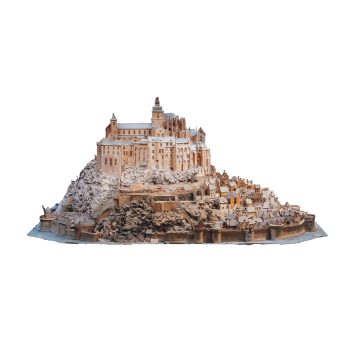
Mont Saint Michel, Normandy, France
It is an iconic historical landmark in the Normandy region of France, located on a rocky island about 1 kilometer from the coast. Renowned for its unique natural landscapes and rich historical and cultural heritage, it has been listed as a World Cultural Heritage Site by UNESCO. The history can be traced back to the 8th century when a monastery was built on the island, which later developed into an important religious center. The monastery complex on the island includes Romanesque, Gothic, and Renaissance architectural styles, and is an outstanding representative in the history of French architecture. Mont Saint Michel is not only a destination for religious pilgrimage, but also an important location for military defense.
Model of Montserrat Palace in Spain
It is a historic architectural complex located in the Montserrat Mountains near Barcelona, Spain. Located on a picturesque mountaintop, overlooking the surrounding countryside and the distant Mediterranean Sea. The history can be traced back to the Middle Ages, initially as a monastery, which was later converted into a palace in the 19th century. The name comes from the patron saint of Catalonia, Saint Montserrat, which is not only a religious holy site but also a center of art and culture. The architectural style combines Gothic and Baroque elements. There is also a museum showcasing art works from ancient to modern times, including paintings, sculptures, and ceramics.
Popular Models
Random Model
walnut combination
127 View
Honda RC166 GP Racing
113 View
TV cabinet
172 View
Blackboard
128 View
Gas bottle
177 View
Fire station
121 View
Realistic Axe
118 View
Solid Wood Storage Rack Bookshelf
166 View